SCOPE — Analysis
Telemetry tells you what a multi-agent system did. SCOPE's analysis tells you whether it thought well.
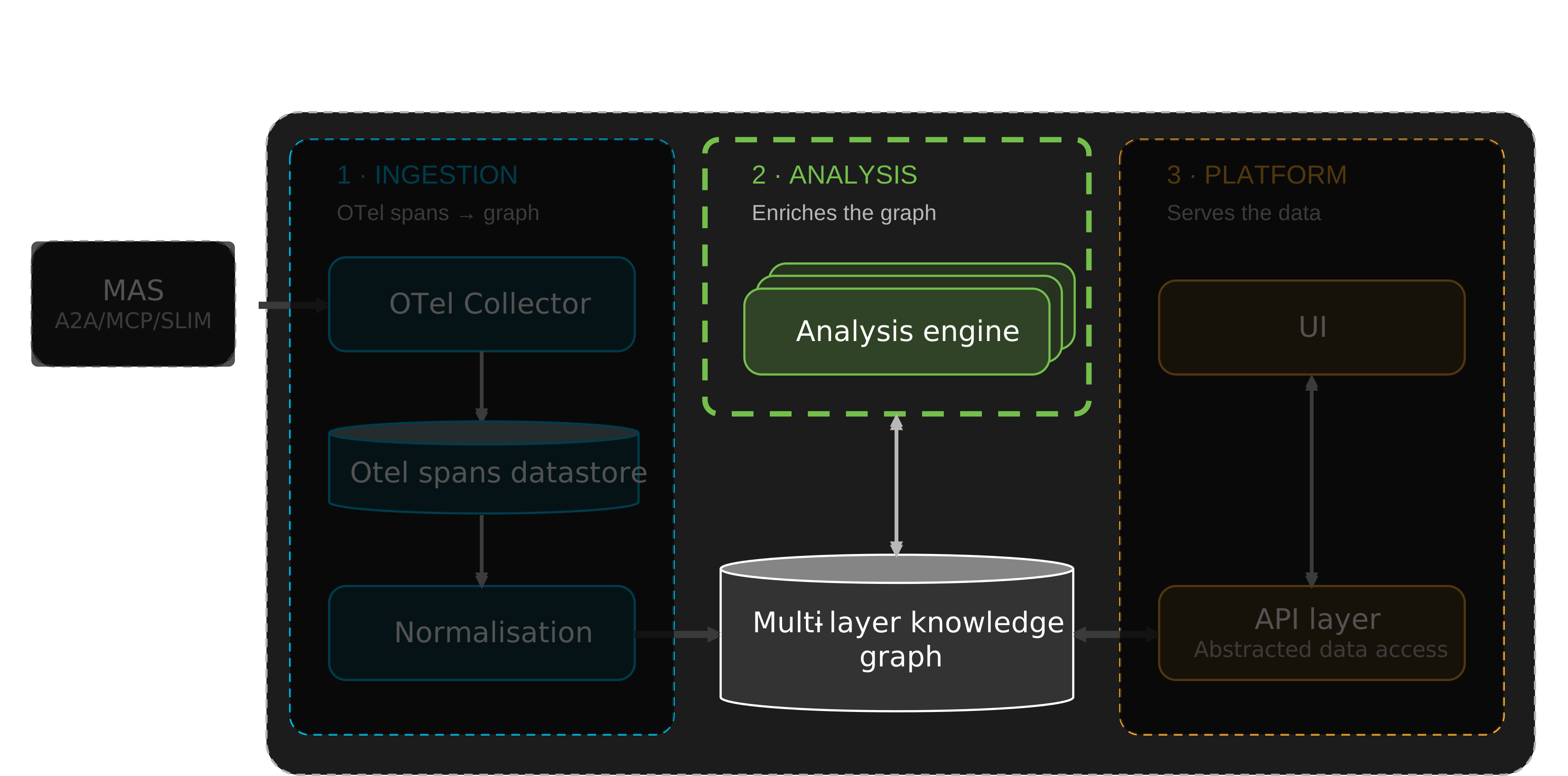
Once a session has been normalised into the knowledge graph, the analysis takes over. It evaluates the session on three questions: was the quality of the answer good, is the system reliable across similar queries, and was its reasoning performant. It also looks for the cognitive failures that emerge when agents work together, such as inconsistent terms, fragmented beliefs or contradictory summaries, none of which show up in latency or error rates.
The result is not a score on the side. Each analysis writes its findings back into the graph as a new layer: embeddings, metrics, semantic groups, anomaly and consistency reports, and insights. Everything downstream reads them from there.
Two families of engines do this work:
- KG-enrichment engines build the knowledge-graph layers, as workers on the ingestion pipeline or on a periodic schedule.
- Platform Engines (PEs) read those layers, name the cognitive failures in them, decide whether to trigger a Cognition Protocol, and measure how protocols are used.
What the analysis engines do
The analysis engines:
- Evaluate sessions on quality, reliability and performance, with quantitative and LLM-judged metrics.
- Group sessions semantically and build a topic hierarchy, so that behaviour is compared only between sessions expected to behave alike.
- Detect anomalies within a group, against a baseline of normal behaviour.
- Measure consistency: how alike the sessions in a group are, on their text, their execution graph and their metrics.
- Derive insights from the graph, rendered from a catalog of templates.
- Detect cognitive failures and attribute them to the source event that caused them.
- Trigger Cognition Protocols in response, and measure how those protocols are used.
These capabilities run as a pipeline of standalone workers over the knowledge graph. The next section is detailing the evaluation process, while the other capabilities are described in later sections.
Agentic Evaluation
Agentic evaluation goes beyond traditional operational metrics. Error rates, cost, duration and latency describe execution; they say nothing about whether an answer was grounded in real data, whether instructions were followed, or whether the reasoning that produced it was sound.
There are three ways to evaluate an agentic conversation, and SCOPE supports all three:
| Method | When it applies |
|---|---|
| Ground-truth comparison | A user-provided expected answer exists and is comparable |
| Application-specific heuristics | A domain-specific answer can be validated by rule |
| LLM-as-a-Judge | Neither of the above applies, which is the common case |
Three dimensions of agentic evaluation
Evaluation is organised into three dimensions. Each is answerable on its own, and semantic analysis strengthens each of them.
| Dimension | The question it answers | Base method | What semantic analysis adds |
|---|---|---|---|
| Quality | Was the answer correct, grounded, relevant and on-task? | Ground-truth comparison, heuristics, LLM-as-a-Judge | A metric dependency tree, so expensive judgements run only where cheaper ones leave doubt |
| Reliability | Does the system behave consistently on similar queries? | Active probing | Semantic grouping and consistency analysis |
| Performance | Was the reasoning process optimal? | LLM-as-a-Judge, cost | Semantic trajectory analysis |
Why the dimensions need semantic analysis
Agentic applications are stochastic: the same question can produce different outcomes. Judging a single session in isolation cannot distinguish acceptable variation from a failure. Semantic analysis supplies the comparison set by identifying which sessions are expected to behave similarly.
Reliability
Reliability is the degree of variability within a session's semantic group. It is measured on three axes rather than one, because they diverge:
- variance of scores,
- dispersion of responses,
- graph edit distance across execution graphs.
A session can be reliable on accuracy, moderately reliable on its execution graph, and unreliable on its textual response. Reporting a single reliability number would conceal that.
Performance
Performance assesses the optimality of the reasoning process rather than the answer: identifying failures, reasoning loops and suboptimal trajectories by comparing a session's execution path against others in its group.
Cost control
LLM-as-a-Judge metrics are expensive, so two mechanisms keep evaluation affordable:
- Metric hierarchies — metrics are arranged in a dependency tree, so a downstream judgement is computed only when the metric above it leaves the question open.
- Stateful and trajectory evaluation — intent, groundedness and relevance are carried as trajectory state across steps rather than recomputed at each one.
The analysis pipeline
The analysis is not one big monolithic program but rather a modular pipeline of standalone workers, leveraging the different analysis engines. Each of them reads from the knowledge graph and contributes back to it on the different layers. Workers can run in two ways: most are chained and run once per session, but they could also be triggered periodically.
The per-session chain
The chained workers are connected by RabbitMQ queues: each worker reads from its input queue, and writes to its output queue, which is the next worker's input queue. The chain runs once per completed session, triggered by a session-completion notification, starting from the normalised session that ingestion has just written.
Partial-session analysis is not supported yet
The protocol trigger loop needs signal while a session is still running. The pipeline as it stands runs on completion; closing that gap is IoC-side integration work, not a property to rely on today.
Periodic workers
Rather than being triggered at every new sessions, workers could be triggered periodically, on their own schedule. The way the periodic workers operate is the same: they read from the knowledge graph and write back to it. Periodic workers can also trigger other workers if need be, by writing to their input queues.
Extensible by design
New analysis engines can be added by subscribing a new worker to a queue, exisiting or new, without modifying the ones that already run.
KG-enrichment engines
The KG-enrichment engines are the workers of the pipeline above. Each one reads the knowledge graph and contributes a layer to it.
| Worker | When | What it does |
|---|---|---|
| embedding | Ingestion | An embedded vector for each state in the trajectory |
| mce | Ingestion | The configured metric set for the session — quantitative and LLM-judged |
| grouping | Ingestion | Assigns the session to a semantic group, using the embeddings |
| analysis | Ingestion | A bundle of three analyses run together over the assigned group — anomaly detection (outlier sessions within the group), consistency (how alike the sessions in the group are, on text, execution graph and metrics) and normal behaviour (the baseline anomaly detection scores against). Reached only if grouping could assign the session to a group |
| stateful-eval | Ingestion | Temporal and stateful metric computation over the trajectory |
| hierarchical grouping | Periodic | Builds and rearranges the semantic-group hierarchy as sessions arrive |
| intelligence | Periodic | Derives insights from the KG from a catalog's templates |
mce and stateful-eval are also the evaluation surface that
MAS-Lab uses to measure the Cognition Protocols.
Semantic grouping is a prerequisite, not a feature
Normal behaviour cannot be defined for a multi-agent system in general, only within a set of sessions expected to behave alike. Grouping therefore has to run before anomaly detection, reliability and wasted-resource analysis can mean anything. It also produces a topic hierarchy, which is what makes a question such as how is the travel agent behaving on refund requests answerable by filtering rather than by search.
Platform Engines (PEs)
PEs are where the analysis meets the Cognition Protocols. They read the layers the pipeline has written to the knowledge graph and use them in two ways: one engine decides when a protocol should run, the other measures what a protocol did once it has.
Cognitive failures in multi-agent systems
Multi-agent cognitive failures originate in breakdowns that infrastructure monitoring cannot see. Once agents coordinate, the environment in which cognition takes place is transformed: agents adopt inconsistent abstractions or naming conventions, beliefs fragment across asymmetric evidence, and summaries become contradictory.
These semantic and epistemic divergences propagate into failures of coordination and collective reasoning — misaligned plans, incomplete reasoning chains — that are invisible to latency or throughput metrics and emerge from interactional dynamics distributed across the team.
Grounded in distributed cognition and shared mental models, the failures organise along two axes:
- the cognitive function whose breakdown produces the failure;
- the locus at which it becomes observable.
That Locus × Function taxonomy is the foundation for what the analysis engines detect and surface.
Cognitive failure detection and trigger
This engine is the sensing side of the Core loop. It turns the analysis into a stream of cognitive signals and acts on them:
- Detects the cognitive failures in a session, each named by its function and locus and attributed to the exact source event that caused it.
- Triggers the matching Cognition Protocol, so that the agents re-open alignment while the session is still running.
- Writes its findings back into the knowledge graph, where the UI and later analyses read them.
Triggering is under development
Triggering a Cognition Protocol from a live session is not yet shipped. For now, the results of past sessions are used to establish the rules that will decide when a protocol should be triggered.
Protocol usage measurement
This engine looks at a whole session, to see what the Cognition Protocols did in it:
- Detects in the session when a Cognition Protocol was activated.
- Computes metrics on its usage, so that the effect of a protocol on a session can be measured rather than assumed.
These results are surfaced in the UI's Cognition Protocols tab for the session. The engine is implemented by the cognition protocols worker.
In this section
- Pipelines — how the workers are chained by queues: the per-session ingestion pipeline, the periodic operations, and how to add a worker.
- Workers — one page per worker: embedding, MCE, grouping, hierarchical grouping, analysis (anomaly detection, consistency, normal behaviour), stateful eval, intelligence, cognitive failure and cognition protocols. The norm worker is documented with normalization.
- Components — the libraries behind the workers: the analysis toolkit, the Metrics Computation Engine, stateful evals, the intelligence catalog and worker base.