Architecture
Three pillars and a validation layer across them
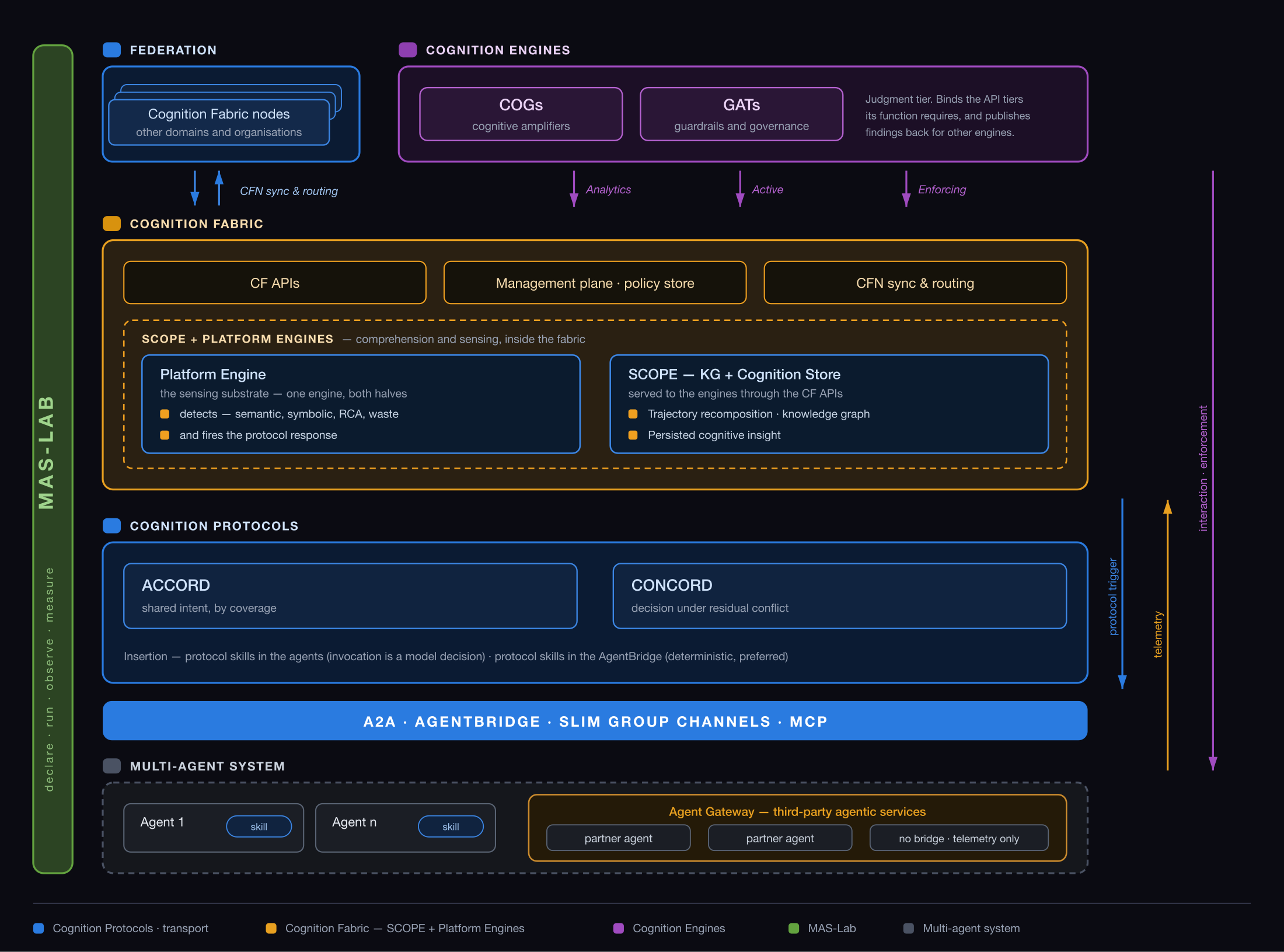
IoC rests on three pillars:
- The Cognition Protocols, which let agents reach a shared interpretation of the work.
- The Cognition Fabric, which records what happened and turns it into insight. SCOPE sits inside the fabric and supplies its comprehension layer.
- The Cognition Engines, which act on that insight to make the collective behaviour trustworthy and more capable.
MAS-Lab spans all three. It is not a fourth pillar but the environment in which each of them is declared, executed, observed and measured.
Each section below covers one pillar: what it contributes, what it depends on from the others, and where it sits in the picture. A final section covers MAS-Lab.
1. Cognition Protocols
Agreement
A family of protocols by which two or more autonomous agents — and the humans among them — establish, maintain and validate shared cognitive state: shared intent, shared meaning, and collectively validated agreement.
They run above an L8 agent transport (A2A, MCP, carried over SLIM) that guarantees messages arrive and are structurally well-formed. A Cognition Protocol's unit of exchange is a fragment of an agent's own cognitive state, and its success condition is not delivery but convergence: every participant ends the exchange holding the same interpretation of what is being solved, in whose terms, and what has been agreed.
What it contributes. Without the Cognition Protocols the other two pillars have nothing to correct. The fabric can observe a disagreement and an engine can name it, but only a protocol can re-open the question among the agents and close it again.
How Cognition Protocols are inserted
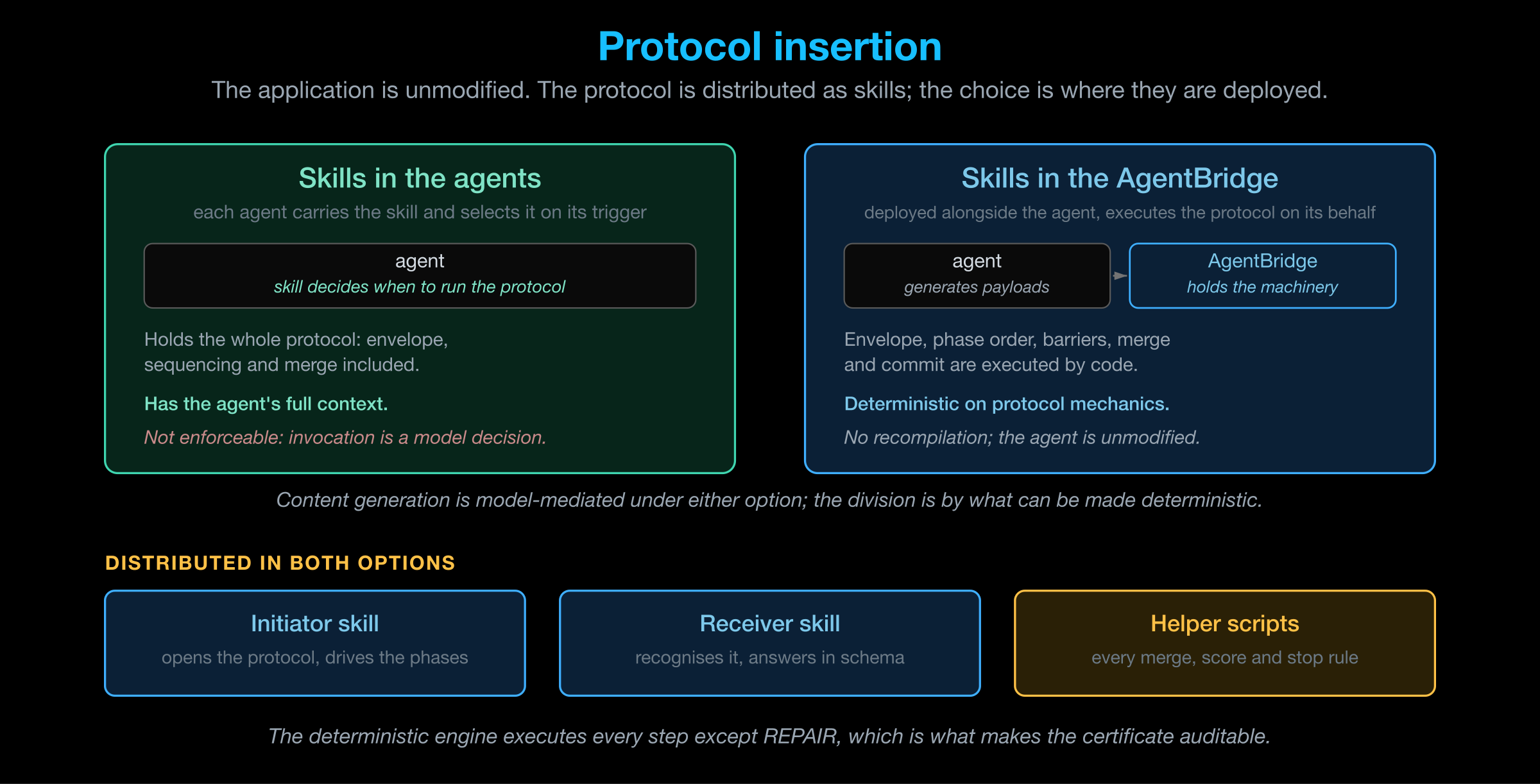
Logically the Cognition Protocols sit above L8. The protocol ships as skills; the choice is where they live, and it is a trade on determinism. The preferred route deploys them in the AgentBridge.
| Route | Invasiveness | Determinism |
|---|---|---|
| Skills in the agents | None — no code change | Weak — invocation is a model decision |
| Skills in the AgentBridge (preferred) | None — no recompile | Full on protocol mechanics; the agent's use of the result stays model-mediated |
The bridge is preferred because it is least invasive. The resolution is a split by what must be deterministic: the bridge owns the protocol machinery (envelope, sequence, phase barriers, merge, commit), while the agent generates the message payloads — content generation could never have been deterministic under any route.
2. The Cognition Fabric
Memory and comprehension
A fabric that complements existing observability platforms to persist agentic context and cognitive insights. SCOPE sits inside it and supplies the comprehension layer: ingestion, normalization, the knowledge graph and the analysis that fills it. The fabric owns the runtime and the contracts; SCOPE owns what populates them.
Because a single agent's telemetry never contains the collective behaviour, the fabric first recomposes the interaction:
- normalize spans from every agent, tool and model call into one execution model;
- reconstruct the multi-hop trajectory under a single session identity;
- build a knowledge graph of agents, transitions, tasks and concepts.
That recomposed object, not the raw trace, is what cognitive analysis runs on — semantic grouping, anomaly and consistency checks, normal-behaviour baselines, impact assessment. What comes out is consolidated cognitive insight, persisted in the Cognition Store alongside the context it was derived from.
What it contributes. Persistence is what makes the system compounding rather than episodic. One engine's conclusion becomes another's input, and understanding accumulates across sessions instead of resetting with every interaction.
The three API tiers
The fabric exposes exactly three surfaces, in increasing order of intrusiveness. An engine's capability is determined entirely by which tiers it binds.
| Tier | Engines can | Engines cannot | In-path component |
|---|---|---|---|
| Analytics (read-only) | Query trajectories, LLM, tool and protocol records, semantic metrics, prior findings | Send messages, invoke tools, block anything | None |
| Active (interactive) | Send messages into a protocol interaction, query MAS tools, participate as an active party | Block, modify or inject in-flight | None |
| Enforcing (control) | Block, modify, inject on live protocol messages and tool calls | Enforce without an in-path component | In-path component required |
The fabric owns the API contract and the routing. The Enforcing tier additionally requires a component in the traffic path, since blocking, modifying or injecting a live message cannot be done from outside it.
The AgentBridge can serve that role. Already deployed as a declared endpoint for protocol execution, it sits at the MAS boundary and can equally apply an engine's decision to the live interaction.
3. The engines
Judgment
Both engine classes read through the fabric's analytics tier and publish their own findings back. They can be simple or complex, deterministic or probabilistic, and are sometimes agentic themselves.
Platform Engines (PEs) are the sensing substrate, and they close the protocol loop. They analyse recomposed trajectories for cognitive failures — named by function and locus, attributed to the originating event — and turn a detected failure into a trigger that re-opens alignment among the agents while the session is still running.
Cognition Engines (CEs) bring higher-level capability:
- GATs (Guardrail Technologies) enforce security, cost and compliance constraints — semantic segmentation, CASA continuous agent semantic authorization, detective investigation.
- COGs (Cognitive Amplifiers) accelerate collective problem-solving — shared memory curation, cost optimization. No COG deliverables exist yet.
COGs address the effectiveness of collaboration; GATs address its trustworthiness.
What they contribute. An engine that can only report leaves the loop open. Binding the Active or Enforcing tier is what lets a finding change what the MAS does next, rather than only describing what it already did.
4. MAS-Lab, across all three
Measurement
MAS-Lab is not a further pillar. It spans the other three: any component described above can be declared, executed, observed and measured inside it.
A multi-agent system is declared as versioned YAML manifests, composed into a runnable configuration, executed under contracts enforced at every boundary, and observed through events emitted at those contract boundaries. Policy and experimental variation are applied as overlays outside the application logic, so a single factor can be varied with the rest held fixed.
What it contributes. Every claim made on this site about a protocol, an engine or the fabric is measured here against a matched baseline. Without it, those claims would be assertions. The measured results reported under Cognition Protocols were produced this way.
How it composes end to end
For a single governed interaction:
- A MAS runs. Its agents talk over L8 (A2A / MCP / SLIM). Cognition Protocols ride above, inserted via the AgentBridge, establishing shared intent and validated agreement.
- Telemetry leaves via any OTel instrumentation, normalized by a SCOPE schema adapter.
- SCOPE ingests it, reconstructs trajectories, builds the knowledge graph and emits Insights.
- Platform Engines analyse those trajectories for cognitive failures and trigger Cognition Protocols to re-align — the loop closing on itself.
- CF holds the enriched model and the Cognition Store, and exposes Analytics / Active / Enforcing.
- CEs bind the tiers their function requires, and publish findings back to the store.
- When an engine needs to act, an in-path component such as the AgentBridge applies the decision to the live interaction.
- MAS-Lab measures whether any of this actually improved coordination.