CONCORD — Evaluation
350 runs across four classes of decision
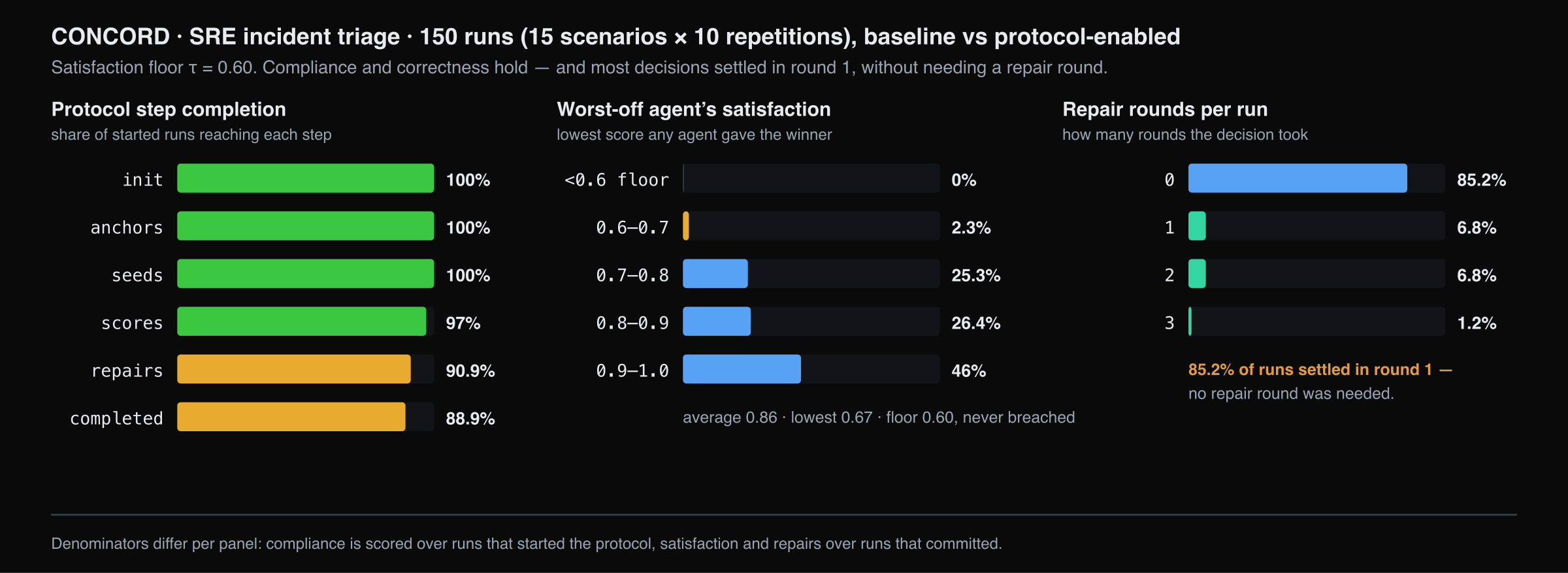
Compliance and correctness
150 SRE triage runs at a floor of 0.60, together with a renewal negotiation, an e-commerce promotion and an information-pooling task.
| SRE triage | Renewal | E-commerce | Hidden profile | |
|---|---|---|---|---|
| Runs | 150 | 10 | 10 | 30 (22 committed) |
| Used all candidates | 97.0% | 100% | 100% | 95.7% |
| Reached a decision | 88.9% | 100% | 100% | 95.7% |
| Agents satisfied | 99.4% | 93.3% | 95.0% | 95.5% |
| Agents not satisfied | 0 | 0 | 0 | 0 |
| Scores consistent with reasoning | 99.3% | 98.4% | 99.3% | 99.2% |
| Worst-off agent, average | 0.86 | 0.73 | 0.77 | 0.86 |
No agent in any committed run finished below the floor on any of the four decisions, and 98–99% of individual scores were consistent with the reasoning recorded for them.
Inconsistent scores are rare and dispersed: 0.7% of individual scores are inconsistent, distributed across 6.8% of runs, so an affected run typically contains a single inconsistent score rather than a consistently divergent agent.
Cost
| Kind of token | Share of tokens | Share of cost |
|---|---|---|
| Cache read | 78.1% | 15.7% |
| Cache creation | 15.8% | 39.8% |
| Output | 4.0% | 40.3% |
| Fresh input | 2.1% | 4.2% |
A run costs 876K tokens and $0.4352, against a ceiling computed before the run opens. Token share and cost share are close to inverted: output and cache creation account for four-fifths of cost while representing a fifth of tokens. Optimisation against total token count would therefore target the lowest-cost component.
Threshold calibration
| Repair rounds run | Share of runs |
|---|---|
| 0 — settled in round 1 | 85.2% |
| 1 | 6.8% |
| 2 | 6.8% |
| 3 | 1.2% |
The worst-off agent averages 0.86 against a floor of 0.60, and in 85.2% of runs the decision settled in round 1.
Those runs did execute the protocol: every agent proposed, every agent scored every proposal, and the floor was verified across all of them. What they did not require was a repair round, since no agent was left below the floor and no bottleneck agent had to author an additional candidate.
Interpretation
Every certificate issued is valid, and verification that all specialists clear a floor is more than the baseline orchestrator performs. However, at this threshold the repair operator is exercised in a minority of runs, which is also reflected in repair rounds accounting for 7.5% of cost.
On this workload a floor of 0.80 would leave approximately 27.6% of runs short and engage the repair loop; 0.90 would leave approximately 53.4% short.
Variation across decision types
| Decision | Runs settled in round 1 |
|---|---|
| Hidden profile | 100% |
| Renewal discount | 90% |
| SRE triage | 85.2% |
| E-commerce promotion | 20% |
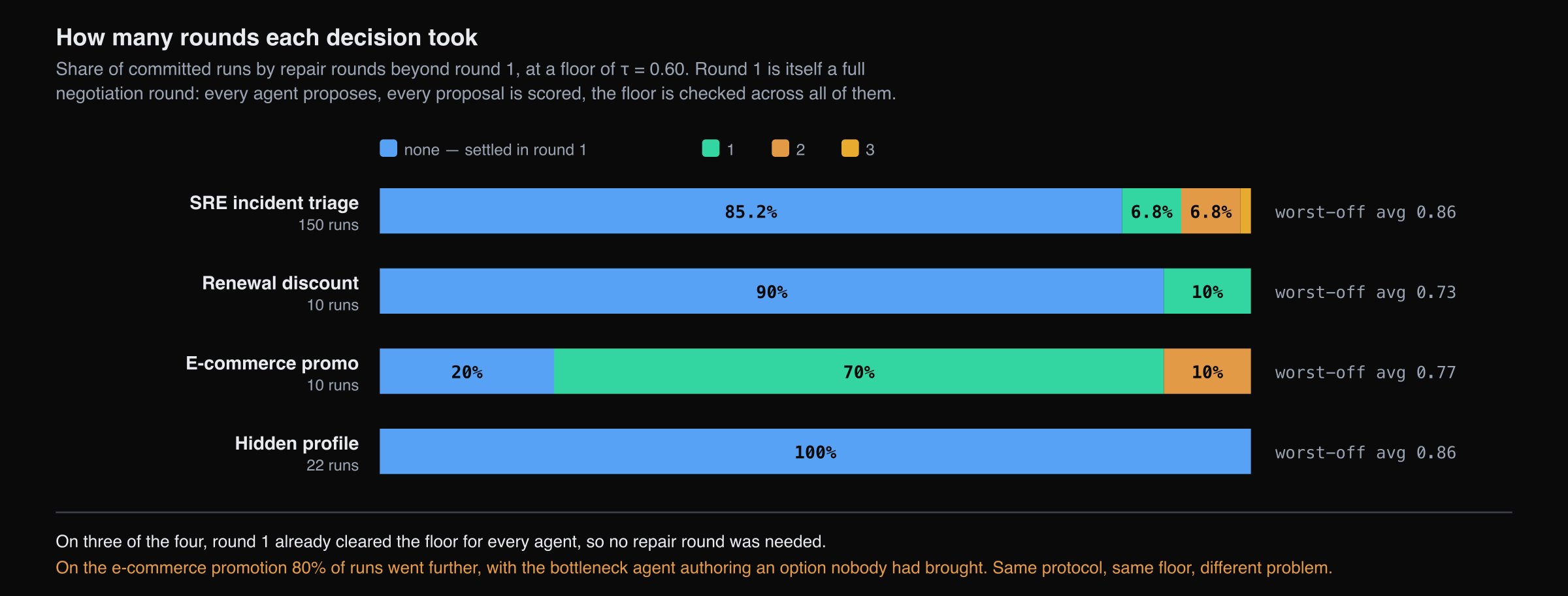
On the e-commerce promotion, 20% of runs settled in round 1, 70% required one repair round and 10% required two. The protocol, floor and engine are identical across cases; the difference is in the decision. Where the specialists represent vendor systems with incompatible objectives, the opening proposals leave at least one agent below the floor, and the repair mechanism is engaged.
Cost therefore tracks the difficulty of the decision rather than the length of the protocol: the repair loop runs in 80% of cases where the roles conflict and in few cases where they do not.
Round 1 is also the first point at which each agent observes the other proposals and the reasoning behind them. A settlement in round 1 does not necessarily indicate that the opening proposals were already compatible; it may indicate that exposure to the other agents' reasoning changed their evaluations sufficiently to clear the floor.
Source
Agreeing on Purpose, Deciding Under Conflict: Two Protocols for the Agent Cognitive Layer — L9 + MAS-Lab T3s, Outshift by Cisco, October 2026.
- Extended version (PDF, 26 pages) — the full study: motivation, both protocols, the evaluation methodology, the use cases, and the results reported here.